Sunday, March 16, 2014

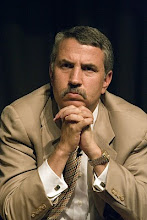
The Mismatch of the Century: Barrett Brown vs. Tom Friedman


Confession: I’m burnt out on Tom Friedman. I hardly ever read him any more, having digested the five columns he lazily recycles over and over far more times than is necessary to get the point or mock. I’m also tired of Friedman jokes, which also suffer from the same problem of being really repetitive -- cabdriver! Even worse, by focusing on his mangled metaphors and stupidity, Friedman’s critics tend to reduce Tommy to a harmless, bumbling caricature, which obscures the fact that, while he is most certainly a bumbler and a caricature, he’s actually been a very effective evangelist for imperialism.

Nevertheless! When I was asked to review Barrett Brown’s chapter on Friedman from his new book Keep Rootin' for Putin: EstablishmentPundits and the Twilight of American Competence, I leapt at the chance. For one, I’m a huge admirer of Brown, the investigative journalist and founder of Project PM, who has been imprisoned for 18 months and faces up to 70 years for the most ludicrous charges. If this review makes my 4 readers more aware of Brown’s plight or gets them to buy a book, the proceeds of which go to his defense fund, great! But the main reason I was so excited was that I would literally read Brown on anything, even boring old Tom Friedman. (If you haven’t been reading the series “The Barrett Brown Review of Arts and Letters and Jail,” put this “review” on hold and go do so.)

Brown doesn’t disappoint. His chapter belongs in the pantheon of great Friedman takedowns, alongside Matt Tiabbi, Belen Fernandez, and the Greenwash Guerrillas who pied The Stache. As always, Brown is a pleasure to read – his unique voice, comic detours, and impeccable timing had me laughing throughout the chapter. It also helps that many of the columns Brown skewers are not the usual ones we’ve come to associate with Friedman’s horribleness.

Take the 2001 column from which Brown gets the book’s title, a cringe-inducing paean to Vladimir Putin written after Friedman flies to Moscow and is blown away by the fact that one can get sushi there (“yes, from borscht to Big Macs to California-Kremlin rolls in one decade!”) He concludes -- based on this observation, another meal at “a combination art gallery-restaurant” and a conversation with his “Russian friend Viktor” -- that Putinism is a good thing. The column ends – seriously – with an exhortation to “keep rootin’ for Putin.”

Putin, Brown points out, was the former head of the FSB when agents were caught red-handed planting explosives in Moscow which they planned to blame on Chechen terrorists. Brown details how questionable attribution of other attacks in Russia was used as the pretext to invade Chechnya and how those who questioned whether the FSB might actually be the terrorists were strong-armed and undermined with dirty tricks. The war on Chechnya proved so popular with Russians that Putin, its champion and architect, easily won the presidency. All of this might have been cause for alarm for Friedman in 2001, but what’s war and manufactured terror attacks compared to the novelty of a “California-Kremlin roll.”

In Friedman’s defense, it’s possible his praise for Putin wasn’t genuine and the entire column was just filler because he thought “rootin’ for Putin” was really clever. One of my favorite passages in Brown’s chapter is when he destroys a column that’s constructed entirely around the fact that Friedman decides to call Colin Powell's military service America OnDuty just so he can contrast it with America Online. This allows Friedman to muse:
He spent thirty-five years of his life with America Onduty, as a military officer. But for the past two years he’s been associated with America Online, as a member of the AOL corporate board. So which perspective will Mr. Powell bring to his job as Secretary of State—the perspective he gleaned with America Onduty during the cold war or the perspective he gleaned with America Online in the post-Cold War?
Suffice to say, Brown has fun with this idiocy.

But back to Russia. It’s now 2008, Russia has invaded Georgia, and Friedman is no longer a Putin man. In fact, he’s so disgusted by Vladimir that he calls out those – like the Bush and Clinton administrations – who were guilty of “short-sightedness” with regards to Putin. Of course, there’s no mention of Friedman’s own Putin vision problem. Being a pundit means never having to say your sorry, or even being aware or honest about what you once said. (One of Friedman’s most frequent lies about himself is that he called for $1/gallon gas tax on September 12, 2011. In fact, he called for Muslim heads. He didn’t float his gas tax idea until October 5, 2003 – when the two wars he cheerled were well under way.)

Brown is a joy to read as a media critic and he expertly fillets a number of other Friedman columns. But its not just talent that sets Brown apart from the other 4,303,301,087 people doing media criticism on the Internet and Twitter. Brown wants to level our pundits not because he wants to replace them with better pundits (there’s no throat-clearing and pointing to himself here), but because he wants to do away with pundits altogether. And pundits need to be slayed not just because their stupid and wrong and always on the side of power, but because the Internet, through things like access to direct material and crowd-sourcing, offers a real and better alternative to our pathetic punditocracy. There’s poignancy in reading Brown's book knowing that he faces life in prison for acting on these ideals.

And then, of course, there’s the fact that while Barrett Brown faces life in a cage, the man he utterly obliterates in Rootin' for Putin lives here:


Free Barrett Brown.

And Fire Tom Friedman.

Friday, November 8, 2013

Imagine

A few weeks ago, protestors at Brown University disrupted a speech by NYPD Commissioner Ray Kelly and forced him from the stage.  It was a sad day for the great liberal values that make America and its elite universities great. It didn’t have to be that way.

As the protestors shout down Kelly, a lone pale figure dressed in tweed stands quietly.He approaches the loudest, angriest protestor and says, “I, too, abhor, police tactics that disproportionately target minorities. But you know what I abhor even more? Incivility! Have you just tried talking to Ray Kelly?”

The loud, angry protestor is taken aback. The man in tweed has touched something deep inside him. He gives one last shout, but this time it’s directed at his comrades, not the stage, “I think we should listen to what the Commissioner has to say.”

One by one, the protestors sit down. This time it’s Ray Kelly’s turn to be stunned. “You’ve taught me quite a lesson here today,” he says. “You had the power, but instead of using it to suppress me, you wielded it wisely and fairly. I had a lecture prepared but you know what, I’d rather listen to you!”

Once again, the protestors rise to recite their grievances against Kelly and the NYPD. But this time, they do in an orderly fashion. They wait in line for the microphone. They address Kelly as “sir.” They hand him pamphlets with beautiful fonts.

As Kelly listens to people tell him calmly and so respectfully how his police department has terrorized minority neighborhoods, tears stream down his face. “I cannot believe how wrong I was,” he wails.

“But we were wrong too,” say the former-protestors. “We should have put our faith in rational discourse.”

There is much weeping and hugging. Kelly announces, “I must call Mayor Bloomberg and tell him the NYPD must change immediately.”

Suddenly, Mayor Mike steps out from behind a tall plant. “You don’t have to call me, Ray-Ray. I heard the whole thing. We only have a few months left in office, but let’s reform the NYPD!”

Dedicated to Conor Friedersdorf, Katha "Weak Tea" Pollitt, and that dude who rightly reminded us that we're not Theodor Adorno.

Wednesday, July 31, 2013

Manning's "Struggles"

There's a pretty repulsive profile of Bradley Manning on the front page of the New York Times today, which declares, "the roots of Private Manning’s behavior may spring as much from his troubled youth as from his political views."  While it gives a nod to Manning's own statements that he was sickened by viewing videos of war crimes, The Times story is basically the latest attempt to assume that  whistleblowing and dissent must be rooted in pathology. So we hear yet again about Manning's conflicted sexuality, his clashes with his father, and some new gems, such as "he spent much of his childhood alone, playing video games or huddled in front of a computer."

I was fortunate to be in Fort Meade on June 3 when defense attorney David Coombs delivered his opening statement, and described the onset of Manning's struggles quite differently.
It was 24 December, 2009. He was 22 years young, in Iraq, his first deployment, his first unit. He was excited to be in Iraq, and he was excited to achieve his mission, and hopefully make Iraq a safer place.

The EFP [Explosively Formed Projectile] alert that went out on that day broke the silence of an otherwise calm Christmas Eve. EFP had claimed the lives of too many soldiers. So when an alert went out, everybody in the TOC [Tactical Operation Center] and in the SCIF [Sensitive Compartmented Information Facility] went into an immediate frenzy to get information.

PFC Manning was sent from the SCIF to the POC to find out what he could find out about the EFP. At that point all they really knew was that an element of the 210 was driving down a road that was rarely used and the lead element had been [inaudible to transcriber]

PFC Manning went to get some additional information but none could be found. They didn't have any updates, so he went back to the SCIF empty-handed. A few tense moments later came the welcome news. Despite the lead element being hit, no soldiers were killed, no soldiers were injured. Everyone in the TOC started celebrating, everyone in the SCIF started celebrating. Good news was welcome on any day, but especially on Christmas Eve.

A few minutes later came some additional news about that EFP, and the report indicated that as the lead element was driving down this road there was this civilian car in front of them, and that civilian car pulled over to the side, as was typical, to allow the convoy to go by, and they pulled over right in front of where that EFP was placed. The car had five occupants, two adults and three children. And that EFP went right through that car and hit that lead element. All five of the occupants were taken to the hospital, one died en route. Everyone in the TOC, in the SCIF was celebrating. Everyone was happy.

Everyone but PFC Manning. He couldn't celebrate. He couldn't be happy. The reason why is he couldn't forget about the life that was lost on that day. He couldn't forget about the lives and the family that was impacted on that Christmas Eve.

And from that moment forward PFC Manning started a struggle.
I may have missed it but I've never seen this story recounted in the mainstream media. It  certainly wasn't in today's Times. But there's a strong case to made that if Manning felt isolated in Iraq, it had less to do with the childhood video games than with the fact he didn't feeling like partying after an Iraqi child was killed.

It is amazing how little, more than 3 years after Manning's arrest, even well-meaning people know about the actual content that Manning leaked or his actual reasons for leaking.  For example, even among many of his supporters there's a sense that Manning leaked for the sake of transparency. But Manning, as least as I read his own words, believed in transparency as a tactic, not the end goal. He wanted to stop the U.S. from committing atrocities -- both of war and "diplomacy" -- in other countries and he used the only weapon he had at his disposal -- information -- to try to do so.

Michael Ratner has argued that one reason for the secret trial is that the government knows that Manning is such a sympathetic defendant.  I agree. Which is why it's so infuriating -- and telling -- that the Times would rather send its armchair psychologists to root through Manning's childhood than let his actions and words speak for themselves.

Thursday, December 27, 2012

My Sequel to Zero Dark Thirty

From Sunday's LA Times:
Khalid Shaikh Mohammed, the man who imagined and directed the 9/11 attacks, was captured by the CIA in 2003. For the next three years he was subjected to the harshest treatment we could stomach. No other Al Qaeda operative in our custody was subjected to so much.
The result? KSM, as he is known within the intelligence community, revealed nothing about the most valuable thing he knew — Bin Laden's whereabouts. He did not, for example, divulge the name of the Kuwaiti courier who served Bin Laden.

This is not coincidentally the piece of information that sets "Zero Dark Thirty" in motion. Mohammed had trained the courier and knew of his connection to Bin Laden. Instead, he sent agents on hundreds of futile chases, hindering the hunt for Bin Laden rather than aiding it.


The simple fact is you can't reliably separate the gold from the dross that torture yields. "He had us chasing the goddamn geese in Central Park because he said some of them had explosives stuffed up their ass," one FBI counter-terrorism agent said in frustration." 
We begin with the torture. A brutalized KSM resists and curses his torturers, but finally shouts out the goose plot.  The camera pulls back and we're in a room full of FBI agents who, we now realize, were watching the KSM interrogation on film.  A stern-faced senior FBI agent addresses the room.  "Gentleman," he intones, "We're going to need someone to look up inside a whole lot of geese's asses."

Boss FBI man scans the room, as the camera pauses over each young agent silently praying he won't be chosen for this distasteful task.  Until at last, we come to Adam Sandler, man-child, reading an Archie comic and blissfully unaware of all that's just transpired.

I"m still filling in some of the pieces, but here's what will definitely be in ZD 30-II: Wild Goose Chase:
  1. A montage of Sandler chasing geese around Central Park.  He's inept.  At one point, he trips and loses his watch, which was given to him by his father, an FBI legend whose dying wish was for his own boy to join the Bureau.  (Hint: The watch will play an important role later).
  2. Lots of hilarious goose poop jokes.
  3. Sandler befriends a goose, who he names Archie.
  4. A shy, lonely office worker, played by Zooey Deschanel, spends her lunch hours in the park feeding geese.  Zooey and Adam begin to notice each other.
  5. Adam and Zooey talk. She's not at all put off by his whole man-child schtick. After all, she's a little quirky herself. And they both love geese.
  6. Zooey and Adam fall in love. (Note: In a earlier version of this screenplay, Sandler falls in love with a goose, not a human.  Still wondering if this might be better.) 
  7. A head-over-heels Zooey comes early to the park to surprise Sandler.  She observes from afar as Sandler holds down a goose and looks up its asshole.  He looks up and sees Zooey looking aghast.  Heartbroken, she runs off.  He yells, "It's not what you think," and starts to run after her, but, just then, Archie crosses his path. The goose has a mysterious metal object protruding out of its ass.
  8. As Adam weighs chasing girl or goose, a sweet-looking boy approaches Archie with a piece of bread. It's time for the man-child to grow up.  He picks up the boy and squires him to safety.  Then he sprints and tackles the goose, and reaches up its ass and pulls out . . . his dad's watch.  With tears streaming down his face, he puts the watch on.  The camera pulls back to reveal a whole bunch of funny park-goers -- a tourist! someone on roller skates! a man with an afro! a drug addict! -- looking on in disbelief.
  9. Zooey refuses to see or talk to the man she believes is a goose-fucker.  Adam is sad.
  10. Adam sees Zooey in the park. Archie is with him.  She turns and it looks like she might give him a second chance when, out-of-nowhere, The Evil Muslim Terrorists grab Zooey.  
  11. Adam and Archie pursue The Evil Muslim Terrorists.  Holy plot twist! The Evil Muslim Terrorists are not Muslim or Terrorists. But boy are they evil.  It's one of KSM's torturers and the senior FBI agent who assigned Sandler to goose duty in the first place. Turns out they always had a grudge against Sandler's old man when he was at the bureau because he hated torture!  Plus, maybe some outlandish plot involving goose smuggling.
  12. Adam saves Zooey.  Now she understands.  
  13. Adam and Zooey get married.  Archie is the best man. KSM (Aziz Ansari, who else?) is at the wedding too, wearing his infamous white t-shirt.
  14. As the credits roll, we see lots of hilarious takes of KSM  being brutally tortured and making up other outlandish plots interspersed with scenes of Archie at the wedding getting really drunk and dancing with hot babes!  The closing joke: A hungover Lindsay Lohan wakes up, her bridesmaid dress crumpled on the floor of her trashed hotel room. She coughs . . . and goose feathers come flying out her mouth!
I'm convinced my sequel will be much better than the original.  Feel free to help me suss out the plot a little more in the comments.

Tuesday, December 18, 2012

Six Rules for Criticizing Obama Over Social Security Cuts

These are confusing times for liberals.  They’ve just awoken from a seven-week bender to discover that their number one sacred cow – President Obama – wants to take a butcher’s knife to sacred cow # 2, Social Security.  Libs are feeling angry, betrayed, and sputtery.  They want to hold Obama’s feet to the fire but aren’t sure how to do so in a way that reassures Obama that they will always have his back. 

Thankfully, liberals themselves have developed – and relentlessly enforced – a number of rules about whether, when, and how it’s acceptable to criticize Obama.  Libs love rules almost as much as they love their rulers so hopefully this will help them get through these troubling times.

1. It is not OK to criticize Obama for something he said he would do before the election.
This rule was best articulated by uber-lib David Atkins, who took to the Daily Kos in 2009 to excoriate the timing of those who dare criticized Obama’s plan to escalate the war in Afghanistan in a piece titled, “Where Were All You People During the Campaign?”

I have watched with no small shortage of puzzlement as much of the progressive blogosphere has taken the Obama Administration to task for its plans to send additional troops to secure Afghanistan from the threat posed by the resurgence of the Taliban.  . . . (W)here was all this sturm und drang from the progressive blogosphere over the need to leave Afghanistan during the primary process, when all the major candidates had made their positions perfectly clear?  Where were the screaming cries of agony during the campaign?
You get that? As liberals will always tell you, the time to for frank criticism of their guy is during the campaign. And what was Obama saying about Social Security then? Well, in the first debate with Romney, he said, “I suspect that on Social Security, we've got a somewhat similar position.” And as Matt Stoller documented back in July, cutting entitlements was always a major part of Obama’s agenda for his second term.
Bottom line: Obama told you he was going to cut Social Security – it’s not his fault if you were too busy monitoring GOP Twitter accounts to notice.  You missed your window for sturming and dranging, so STFU.

2. Obama is smarter and knows more than you do.
"I'd literally trust his judgment over my own. I think he's smarter than me, better informed, better able to understand the consequences of his actions, and more farsighted. I voted for him because I trust his judgment, and I still do." – Kevin Drum, Mother Jones

Why does Obama want to want to cut Social Security? We don’t know but the fact remains that we are not privy to everything that Obama knows – and we probably couldn’t understand it if we were.  Maybe Obama is banking on the fact by the Post Office will be closed by the time the cuts take effect so there won’t be anyone to deliver benefit checks. Maybe he realizes that shit will be so fucked up from climate collapse that no will live to see sixty-five in the coming years.

Bottom line:  Obama knows what he’s doing so STFU.

3. Always consider the alternatives.
For those complaining about Obama, ask yourself this:  Is there another politician you’d prefer to cut Social Security?  Because we don’t love in some utopia where grandma gets to pay for food and heating oil.  Your choices were Obama cutting Social Security or Romney  cutting Social Security. And personally, I’ll take Obama every time.  At least Obama will act humble and pained about fucking over seniors.  Are you honestly telling me you’d prefer Romney’s smirk?

Bottom line: Grow up and STFU.

4. Pause to smell Obama’s greatness.  And take gratuitous shots at Ralph Nader.
Last night, Chris Hayes took to Twitter to express his dismay that Obama was considering cuts. When friendly Tweeters responded that they were surprised that Hayes was surprised since Obama has clearly been gunning for entitlements for some time, Hayes quickly dropped his Social Security complaints and moved on to weightier matters:
Honest question for lefties who think Obama is horrible. Who do you see as better, more progressive American presidents?
To which Dan Savage replied, “Remember President Nader? He was so awesome.”

(For readers unfamiliar with American history, there was no President Nader! Savage is making a brilliant, biting joke designed to belittle anyone unhappy with President Obama.)

Bottom line: Grow up and STFU. And Fuck Ralph Nader.

5. Remember Obama’s heart is always in the right place. If you must criticize him, do so only on tactics.
As liberals will endlessly tell you, if Obama has one flaw, it’s that he sometimes thinks too much of people. He has, for instance, failed to recognize that the Republicans are the party of Satan.  He consistently tries to bargain with the GOP and sometimes, because of his desire to promote bipartisanship, Obama will sound and act exactly like the enemy.  This combination of GOP evil and Obama magnanimity occasionally leads to people getting screwed. Badly.  But we can all agree that that’s not what Obama really wants.

So while it would probably be best if you just STFU about Social Security, please remember the following if you feel, out of some nagging sense of principle or concern for humanity, that you must say something:
    A. Anything bad Obama does is primarily the GOP’s fault.
    B. You can criticize Obama for “caving.” You cannot criticize Obama for wanting to cut Social Security. (You might want to forget everything you read in rule # 1.)

    Bottom Line: Fuckin’ Republicans.

    6. Keep your eye on the big picture.
    It is tempting to lash out at Obama and the Democrats for slashing  caving on Social Security. But remember, Social Security is an incredibly popular program and if voters start associating Democrats with benefit cuts, that’s not going to help come November, 2014.  Imagine Obama’s last two years in office if we win back the House and hold onto the Senate in the midterms. We could restore the Social Security cuts, ban guns, reverse climate change, and maybe even bring those Pakistani kids back to life.
     
    But that’s not going to happen if you keep whining about grandma, is it?

    Bottom line: We love you Obama.  And if we ever doubted you, that’s our failing, not yours. 

    Tuesday, November 20, 2012

    The Courage of the Progs

    With all the horrific images and stories coming out of Gaza, it’s easy to overlook the true victims in this tragic story: progressive bloggers. Thankfully, Digby’s right-hand man, the courageous David Atkins, is here to shed some much needed light on the bombs of hateful comments being tossed their way.

    Atkins’ piece is a response to criticisms that progressive bloggers have largely ignored the assault on Gaza. (While the assault was escalating this weekend, Atrios took to his blog to announce, “I Got Nothing To Say.") For Atkins, there are three reasons why progressive bloggers don’t want to get their hands dirty on this one. These reasons are neither accurate or legitimate, but they are unintentionally illuminating enough to rouse Fire Tom Friedman out of a pathetically long hibernation. So without further ado, here’s Atkin on why the progs are right to keep quiet:

    1. Incoherent, hateful backlash. The fact is that it's impossible to say anything substantive about the Israel-Palestine conflict without being called a hateful anti-Semite, or a hateful bloodthirsty imperialist. Most hilarious is the notion that silence on the issue is caused by defense of the Administration, as if most of the progressive blogosphere had been somehow aggressive against the Bush Administration for failure to be concerned about the Palestinian people. If one examines the archives, one will see that most of the big sites from Atrios to DailyKos to TPM to Hullabaloo and the rest have largely refrained from commenting too much on the issue for years, long before Obama took office. That's in large part because nothing can be said about it without eliciting a horrifying deluge of asinine commentary that no other issue seems to generate. Especially for unpaid bloggers more concerned with climate change, the predations of the financial sector, the ongoing assault against the middle class and women's rights, etc., it's often not worth the headache of being called a vicious anti-semitic terrorist enabler and/or imperialist apartheid murderer--often for the exact same post. 

    Really, Palestine – shut up about your dead kids. As Atkins so forcefully reminds us, the brave men and women who take to the internet several times a day to generate page views for their personal blogs and those of their employers have feelings, too. Do the people of Gaza know what it’s like to endure a “horrifying deluge of asinine commentary?” Have they ever been called “a vicious anti-semitic terrorist enabler and/or imperialist apartheid murderer--often for the exact same post?”

    And as Atkins points out, it really is only “the Israel-Palestine conflict” that brings out this vulgarity on the internet. If only the commenters would be as restrained as they are when they discuss the recent election or immigration or marriage equality or anything having to do with non-Palestinian Muslims, I’m sure Atkins and co. would be happy to weigh in.

    Easy mockery aside, Atkins does have one point. The idea that the prog blogs are keeping quiet because of who is in the Oval Office is demonstrably false. Those who are cowards today when it comes to calling out Israel for war crimes, apartheid, and occupation were cowards during the Bush years as well. But that's because it's party orthodoxy, not the presidency, that matters. Progressive bloggers didn't oppose Bush’s Israel/Palestine policies because the Democrats didn't.

    Prog blogs have plenty to say on issues – and only on those issues -- where there are real (e.g. marriage equality) or perceived (e.g. climate change*) differences between the parties. But on Israel, the parties don’t even pretend to disagree (witness the Senate’s unanimous passage of a resolution written by AIPAC this morning) so there is simply no role for progressive bloggers to play. Maybe this is all just a long-winded way of saying progressive bloggers are Democratic mouthpieces. Not exactly news, I know. But it strikes me that by daring to talk about why progressive bloggers don’t dare to talk about Israel and Palestine, Atkins may have unintentionally exposed why the progressive blogosphere is so fucking harmful.

    Atkins being Atkins, he lists two more reasons the progs don’t do Israel that range from horribly offensive to asinine. His next reason, “2) There are no good guys here,” got my hopes up, but it turns out he’s talking about Israel and Palestine, not the progressive blogosphere. There’s enough nauseating equivalence  between the occupiers and the occupied in this section to make you want to call Atkins “an imperialist apartheid murderer.” Do yourself a favor and skip it.

    Atkins may save the best for last, though, when he writes, “3) There's nothing we can do about it. It makes sense to blog about things that we can theoretically do something about.” It may be news to you and me that cutting off subsidies for Israel’s war machine is something the United States can’t even do in theory, but we don’t get invited to the same DNC cocktail parties as Atkins. So maybe he’s right and progressive bloggers should focus on manageable, easily solvable problems, like climate change. They should have that one solved by next spring – just in time to sit out Israel’s next assault on Gaza.


    *My favorite election season quote came from Matt Stoller, who wrote, "Partisans may enjoy Mitt Romney’s corrupt denial of man-made global warming, but nature doesn’t distinguish between Obama’s cynical lack of action and Romney’s cynical denial of reality. We simply do not have time for this nonsense anymore."

    Thursday, January 12, 2012

    Meet Arthur S. Brisbane, Truth Vigilante!

    Arthur S. Brisbane, the most timid in a long line of timid New York Times public editors, is having an existential crisis. Brisbane is supposed to be The Times’ “readers' representative . . . who responds to complaints and comments from the public and monitors the paper's journalistic practices.” Brisbane has sailed through his first 18 months on the job, but now one of those pesky readers he’s supposed to be representing has asked him a real stumper.

    Shouldn’t the Times, a reader emails, point out when the subject of a story is lying rather than just dutifully passing along those lies? The idea that a reporter should challenge the falsehoods of the powerful is so foreign and radical to Brisbane, whose been working in the newspaper business since 1976, that he doesn’t even have a word in his vocabulary (“fact-checking!” “reporting!” “journalism!”) to describe it. So he settles on the most straight-forward, rolling-off-the-tongue phrase he can think of: “truth vigilantism.”

    In a provocative piece entitled, “Should The Times Be a Truth Vigilante?” Brisbane asks what reporters should do if, say, Mitt Romney excoriates President Obama for “apologizing for America” when, in fact, the President has done no such thing? (Turns out the Prez is just fine with America being the world’s most destructive force.) Should the Times point that Romney’s pants are on fire or just what Mitt said? There are, Brisbane notes, “some readers who, fed up with the distortions and evasions that are common in public life, look to The Times to set the record straight.” Of course, it’s not just the distortions and evasions in public life that readers are fed up with; it’s also the distortions and evasions in The Times. And framing it as a question of "setting the record straight" ignores the fact that The Times isn't just reporting what the liars say; it's amplifying those lies.

    Regardless, it’s a pretty remarkable piece that deserves to be read in its entirety, though preferably not while drinking a hot coffee or anything else that might damage your nasal passages. And Brisbane’s musings have already made quite a difference. For one, through sheer stupidity, Brisbane may have accidentally done more to draw attention to the fact that many of The Times “reporters” are mere stenographers than his three predecessors combined. And it’s propelled Brisbane from the guy no one knew existed to an Internet joke in just a few hours.

    But alas, despite the fact that the 265 comments on Brisbane’s article all advocate for actual reporting, I predict that the only lasting result at The Times will be that Brisbane won’t be Public Editor much longer. Don’t cry for Arthur, though. I’m sure he’ll land a nice cushy job at teaching in the Truth Vigilante department at some prestigious university . . .